Ecology

Palms of Fiji

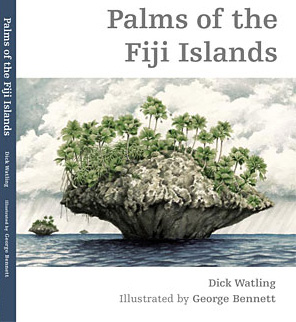
Palms Of Fiji CoverThe coconut and the Fiji fan palm are by far the best known of Fiji’s palms, but both may actually be old introductions to Fiji. This new book, the first ever published on the subject, describes the 31 species of palm that may be found growing wild in Fiji today; 25 of these are considered native and six are introduced. The book is lavishly illustrated by renowned wildlife artist, George Bennett.

Fiji’s palms are poorly known; indeed, two ‘species’ are not even scientifically described. They vary in size and form from the delicate 3-4 metre Balaka seemannii to the recently described Hydriastele boumae which is as tall as a coconut and emerges from the forest canopy. Half of Fiji’s endemic palms are on the world Red List of endangered plants and are officially categorized as threatened with extinction. The plight of Fiji’s palms is a microcosm of the plight of Fiji’s forests which are being butchered and burned, year in and year out, with hardly a murmur of public concern. Palms are a very appropriate conservation flagship for the Fiji Islands and also provide a wonderful opportunity for some of the more academic interests of the vulnerability of island floras and extinction processes.

Buy now: Palms of the Fiji Islands

Dick Watling Ph.D.
Environment Consultants Fiji
Websites: www.environmentfiji.com ; www.pacificbirds.com

Eco Tripping Around the World

During my travels I am wrote articles on a series of ecological projects under or above the water in different locations for SEED Magazine.

The first is about a character called uncle Pa in Jamaica: "Long Bay is a sleepy little seaside town in the northeastern parish of Portland, Jamaica. In the nearby hills southwest of the seaside, I met Uncle Pa, a 79-year-old man who is toothless but incredibly hardy. He has been going into the bush since he was a kid and, from the age of 19 on, he has provided sustenance from its vegetation for his 17 children. He knows every tree and shrub as well as the medicinal effect of every piece of bark, every leaf and every flower." Read more...

The second tells about Dinah Veeris and her botanical/medicinal garden in Curacao: "I met Dinah Veeris in her magnificent botanical garden where she propagates over 300 species of wild medicinal plants. The garden is called “Den Paradera,” which means “the place where you feel at home”. Dinah was born in Curaçao in 1939. She is soft-spoken with a humble and calm presence, most likely derived from her 50 years working as an educator." Read more...

The third article investigates rebuilding a shallow water ecosystem in the Dutch Antilles: "I’ve done over 400 dives all over the world, including Hawaii, the outer islands of Fiji, the Cook Islands and Scotland, but I have never seen so many different types of fish or been able to observe their natural behaviors as closely as on Bari Reef." Read more...

The fourth article I stumble across a Living Machine in the middle of a Hawaiian Gold Course: "At the Hualalai Resort, situated on the stunning Kailua-Kona Coast of Hawaii’s Big Island, humans have built a lake that functions as a “living machine” capable of filtering water, producing food, and sustaining populations of birds, fish, and plants native to this island chain." Read more...

The fifth articles sees that my 2003 efforts at environmental restoration in Hawaii established plant life in a barren area: "In 2003, I was fortunate enough to join a three-month ecological restoration class with Jill Wagner from Tree Hawaii, a non-profit, environmental educational organization. During this 12-week course, we learned about native habitat restoration in Hawaii through the collection of native seeds and the propagation of plants. We participated in forest habitat restoration at Kaloko-Honokohau National Park, which sits below the majestic Hualalai Volcano on the Kona Coast of the Big Island." Read more...

Crystal Waters Permaculture Village

Crystal Waters Permaculture Village is a socially and environmentally responsible, economically viable, rural subdivision about 100 km north of Brisbane in Queensland, Australia. It was started in 1981 and in 1996 it received the World Habitat Award for its "pioneering work in demonstrating new ways of low impact, sustainable living".
 
There are 83 freehold residential and 2 commercial lots occupying 20% of the 259ha (640 acre) property. The remaining 80% is owned in common. It can be licensed for sustainable agriculture, forestry, recreation and habitat projects.

Crystal Springs Permaculture Garden

Permaculture is an important aspect of their way of life. Permaculture means efficient and productive use of the land while taking care of the earth. Permaculture looks at the incredible diversity of plant and wildlife, the intricacies of eco-systems with their natural checks and balances and uses this knowledge to create a sustainable way of life. Permaculture cares for the earth, for people and distributes that which is surplus to
requirements.
 
Barry O’Connell, the guide for my tour group, had a very simple philosophy. He said permaculture is “to fit.” It has to fit the environment and fit the needs of the people.

Barry Founder Crystal Springs

Anyone can live in Crystal Water as long as they agree to the by-laws (local laws) of the land. An example of a by-law is that residents are responsible for the provision of their needs and the disposal of waste within ecological parameters. One interesting by-law is that residents are not allowed to have a cat or a dog, with the exception of a guide dog for a blind person.
 
On a very unusual, rainy day our guide, Barry, welcomed us. He had organized a talk with one of the co-founders, Barry Goodman. He lived at the far end of the subdivision so we drove through a wonderful landscape of native trees, lakes and kangaroos.  We arrived at his ecologically friendly, pole frame house, built from timber, and his permaculture garden. What was most noticeable was the incredible peace and the clear sounds of birds.  He talked about some of the infrastructures of the community and how different managers (ranger, land manager, office manager, and bookkeeper) looked after certain aspects of the subdivision.

Composting Toilet

I asked him what he liked most about living in Crystal Waters and he was very quick with his answer. He said he had the best friends he had ever had and he liked the lifestyle and the physical environment. He disliked the community politics though.
 
Various people and businesses offer a variety of educational services there. Some examples of courses they run are Ecovillage Design Courses, Permaculture Design Courses, Sustainable Community Development and also University programs.
 
During our visit we had lunch with a group of 20 Koreans who had just finished an Ecovillage Design Course that lasted a week. I was delighted to meet them. They came from all walks of life. Some were from the Korean government, several were leaders of Korean Ecovillages and some were representatives of ecologically-minded businesses. They were touring ecovillages around the world.
 
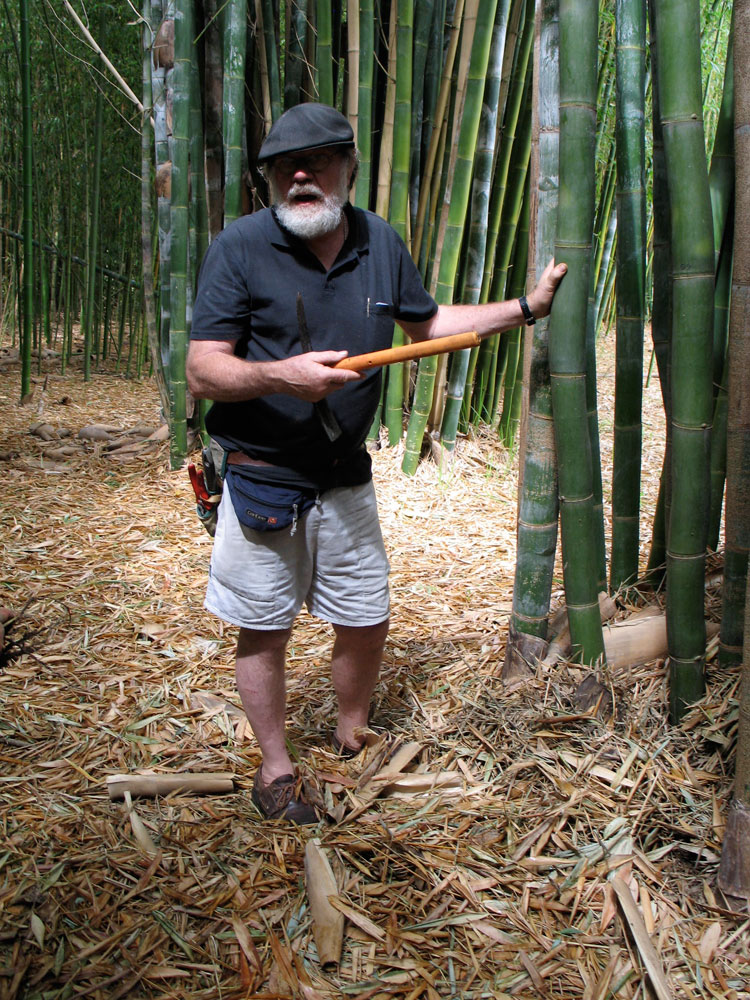
After lunch Barry took us for a tour around the bamboo farm. I thought Bamboo was an invasive species, but I was told they contain the bamboo by growing cluster bamboo around the edge. The more aggressive runner bamboo was in the center and was contained. We also visited the bakery where organic bread was baked on a wood fire.

Barry in the Forest

What I liked most about Crystal water was that the people who lived there looked after their own livelihood in a very ecological way and also that the community had their own fire protection (fire brigade), built their own roads, managed their water supply, weed control, firebreaks and more.
 
It is a place that is well worth visiting and a great example to the world!

Bonaire Banded Box Jellyfish

By Marijke Wilhelmus

Snorkeling in Bonaire is wonderful; the sea is full of fascinating marine creatures. One glorious afternoon my son Clark and I went snorkeling near our house. Luckily we brought our underwater camera and we spotted this amazing, interesting looking Jellyfish. That same evening I emailed one of the pictures to our local biologist. He said that is was the very rare and highly toxic Bonaire Banded Box Jelly (Tamoya ohboya - read more about the funny story behind this name) and the 36th documented Bonaire Banded Box Jelly since 2001 and a new species!  Experts think Tamoya ohboya is only to be found in Bonaire waters.  Find it mentioned in "What on Earth?: 100 of Our Planet's Most Amazing New Species" with a credited picture from me.

The jellyfish is a strange and fascinating marine animal that is found in all the oceans of the world from the waters surface all the way down to the deep sea. They are one of the oldest living beings and more than 650 million years in existence.

What makes it fascinating is the fact that it does not have a solid skeletal structure, or a brain, or a heart.

Caribbean Banded Box Jelly

Guess how many eyes a Bonaire Banded Box Jelly has….

Each jellyfish has six eyes, if you can believe that! Two of them actually have lenses, pupils, and retinas, whereas the remaining four are just light sensitive. The eye is also a balance organ, telling the jellyfish which way is up.

They are made of 95% of water. This is the reason they can't navigate well through water and have to depend on the water currents and tides for easy transport, and also to get them closer to their food.

BBBJ Details

What do Jellyfish eat?

Most jellyfish are passive drifters that feed on small fish, eggs and plankton that become caught in their tentacles. The stomach is the only opening in its body and the food is digested there and the waste also comes out from there.

Jellyfish have stinging cells. Whenever a prey comes in contact with a tentacle, hundreds to thousands of stinging cells fire a type of "hook and line" into the prey's direction. These stinging cells are able to latch onto the prey and the tentacles bring the prey item into their large "mouth" for digestion.

And what eats Jellyfish?

Jellyfish are eaten mostly by a couple of other fish, crabs and loggerhead turtles. People in China and Japan like to eat the mushroom jellyfish.

How big does a Jellyfish get?

In the Caribbean there are some jellyfish, which come as small the nail of a finger. On the other end of the scale the Arctic Lions' Mane jellyfish has a bell of up to 2.5 metres and tentacles, which can reach up to 60 metres. This gigantic jellyfish is thought to weigh over two hundred and fifty kilograms.

Tamoya Ohboya Bonaire

Why are there more jellyfish now?

In more recent times there has been a dramatic rise in jellyfish numbers. Overpopulation of Jellyfish is being caused by over-fishing, global warming, and also an excess in the levels of nutrients in the water due to sewage and fertilizers.

More recent jellyfish blooms show that the jellyfish population incline is becoming more and more severe and frequent. With such large numbers of jellyfish in the waters there will certainly be a very dramatic impact on fishing and food supplies. The more jellyfish that are in the sea, the more they will eat, and the less food there is for the other marine creatures which share their dietary interests. Another problem is for swimmers, with so many jellyfish in the water it may very well become almost impossible to go for a swim.

Did you know that discovering new species relies on:

•    Creativity
•    Logic
•    Technology (sometimes simple, sometimes complex)
•    Problem Solving Skills
•    Adventure
•    Good writing skills

Do jellyfish communicate?

Jellyfish do not communicate like we do; they do not have a brain or language but some can flash colourful lights. Scientists think these may be used to disguise them or even to attract prey. Jellyfish can signal each other. One jellyfish releases chemicals when it is about to breed. Other jellyfish then are stimulated to spawn at the same time, so that the most jellyfish are born.

This is a very rare and highly toxic Bonaire Banded Box Jelly and the 36th documented CBBJ since 2001!

More Articles ...

  1. Echo Bonaire
  2. Ecology